Design Operations · BT Group
Closing the gap, not the door
How BT Group is bringing AI code editors and agents into design, starting with the design system and spreading out to hundreds of designers across 3 tribes and 3 brands, without breaking what works with engineering.
14
Designers with access so far: 11 senior designers and 3 design leads
1
Approved workflow, from Figma to GitLab
3
Tribes and 3 brands to bring along
- Role
- Co-lead, with a senior designer on Loop
- Timeline
- 2026 → present
- Team
- Loop design system team
- Tools
- Figma MCP, Kiro and GitLab
Context
Design is changing
The gap between design and code is shrinking fast. Code editors and their agents let designers build with real code, but vibe coding only gets you so far: engineers are still as important as ever.
Across BT Group, some design teams were already exploring editors and agents with their developers, while others weren’t using them or even thinking about it. It was becoming every tribe for itself, a mini AI race inside the company. That’s no good for shared ways of working or for adopting the design system, and Loop wasn’t even part of it yet.
The brief
How might we bring AI into how we design, from the design system outwards, rather than tribe by tribe?
Co-led with another senior designer on Loop. It’s an important time for design and for the company, and a delicate one: we don’t want to sour relationships with developers, in other teams or in our own.
Success looked like
- One approved workflow for design and engineering
- Coded prototypes built from Loop’s foundations, components and patterns
- Relationships with developers kept strong
Constraints
- Expensive, with a monthly token limit, and seen as a dev-only tool
- Security: packages, certificates, VPNs, access and MCPs
- Developers still QA everything before it merges
Approach
Start at the core, and let it ripple out
Not an overnight change. At a company this size, with hundreds of designers in internal teams, plus contractors and external teams, at every level of skill, it has to be a gradual rollout.
-
Make the case
With design managers and leads, we took the case up to senior engineering management, building relationships along the way, so design system access wasn’t seen as taking anything from developers.
-
Get set up
Kiro approved, with credit limits, and connected to GitLab. Then the real hurdle: the agent can only set up so much, so Loop’s lead React engineer requested permissions for each designer from engineering management and DevOps.
-
Build from the core
The design system team goes first, so new ways of working are built on Loop and spread to other teams from there.
-
Capture what works
With management and senior designers, write down the workflows that work for each team as access widens.
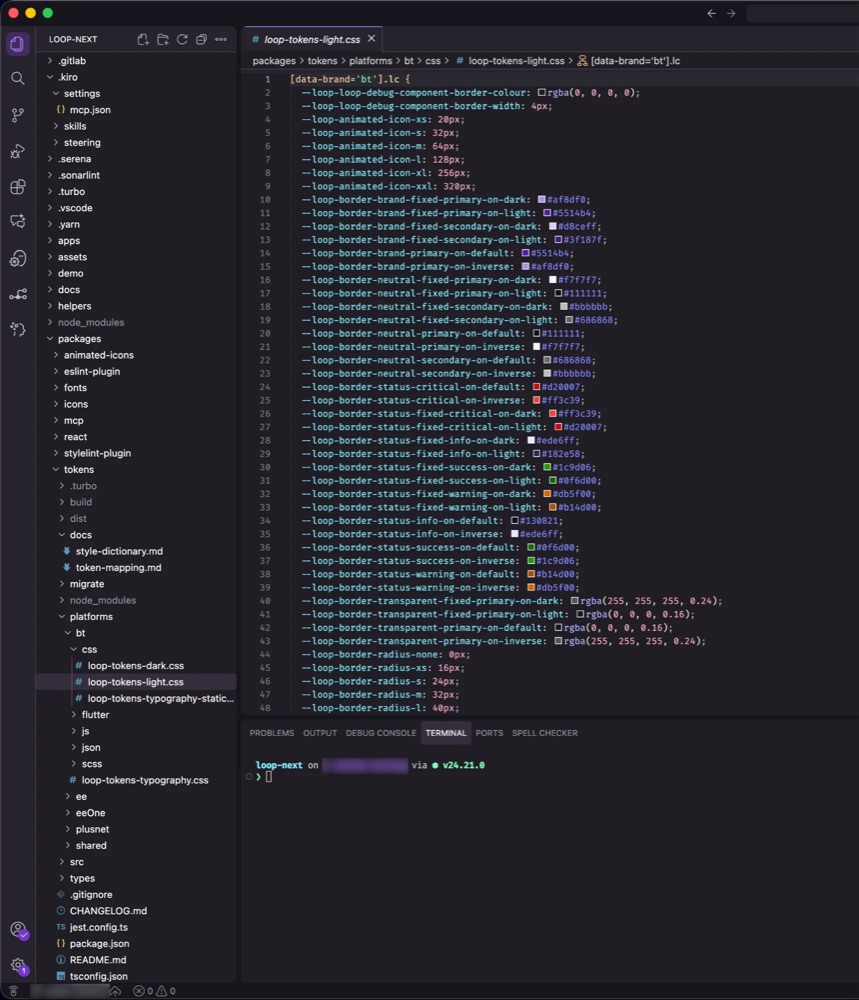
- .kiro: Loop’s steering files and the MCP config
- platforms: a folder of tokens for every brand
- open: BT’s light tokens, built from Loop
Key decision
The design system first, not every team at once
Kiro was expensive and seen as a tool for developers. Getting access for the design system team wasn’t easy, but it meant the new way of working would grow from the core of design.
Option A, not chosen: Let each tribe go its own way
Faster for the teams already exploring, but every team ends up working differently, and Loop is left out of the picture.
Option B, chosen: Start in the design system team
Build the workflow on Loop first, then roll it out team by team, so every team gets the same system and the same way of working.
Outcome
Design in Figma.
Build in Kiro.
Review in GitLab.
Kiro is now the editor and agent the company has approved for engineering and design, with a monthly token limit. It’s built on VS Code, so it feels familiar. Its specs turn an idea into requirements, a design and tasks. Its steering files hold Loop’s rules, so the agent builds with the system, and MCPs connect it to Figma.
Figma isn’t going anywhere. It’s still where designers design and explore, with every component and variable mirrored there, and Code Connect links Loop’s components to their code, so the agent uses the real ones. But the source of truth is becoming code. The codebase is mature, so designers have guardrails: Loop’s own lint rules, types and tests catch mistakes before a developer even looks. And developers still QA every change before it merges: we’re not replacing their work.
So far, 11 senior designers and 3 design leads have access. It’s still a work in progress, rolling out as budget allows.
What I learned
- At this scale, the change is about people more than tools
- Vibe coding only gets designers so far
- Onboarding needs engineers: the agent can only set up so much
What I’d do next
- Widen access, team by team, as budget allows
- Share the workflows that work across tribes
- Make it the new normal, as Figma is today
Say hi
Let’s talk about what’s next…
Or we can talk video games, golf or skateboarding :)